

It’s 2026, and SaaS is everywhere. There are tools for sales, payroll, marketing, support, and every key function a business relies on. These apps are quick to set up, easy to use, and full of features. But they haven’t replaced everything. Custom software still has a strong place in today’s business world, especially for companies with unique workflows, specific challenges, or complex systems. In this article, we’ll look at why custom software still matters and when it might be the better choice for your business.
Why SaaS Looks So Good
At first glance, SaaS (Software as a Service) solutions seem like a dream come true.
- Quick sign-up: You can create an account and start using it within minutes
- Monthly pricing: No big upfront investment, just pay as you go
- No setup or maintenance: No need to worry about hosting, updates, or IT headaches
- Instant access to features: Everything is already built. Dashboards, automations, and integrations
- Perfect for general needs: Most SaaS tools are built to cover a wide range of basic requirements across industries
If you’re just starting out or running a lean operation, SaaS is often the fastest and cheapest way to get moving. You can test ideas, manage daily work, and appear “tech-ready” without hiring a developer or building anything from scratch.
But here’s the catch. This convenience is built for the average user. And once your business starts growing, things get more complicated. You might find yourself wishing the tool could do something it wasn’t designed to do. Or that it integrated better with your team’s actual workflow. That’s when the glow starts to fade.
Let’s look at what happens when that early convenience turns into friction.
Limitations in Ready-Made Solutions
Even the most popular SaaS tools can fall short. You might find yourself thinking, “This would be perfect if it just did that one thing we really need.”
That’s the catch with ready-made software. These platforms are designed for broad use, not for your specific business. They do a lot, but they rarely do everything the way your team needs.
Here are a few common issues businesses run into:
- Limited customization: You can tweak settings, but you can’t shape the tool around how your team actually works
- Workflow misalignment: You end up adjusting your process to fit the tool instead of the tool supporting your process
- Difficult integrations: Connecting with legacy systems, internal tools, or industry-specific software can be a struggle
- Paying for features you don’t use: You’re stuck with a full package when all you need is a fraction of it
- Vendor lock-in: Migrating away or switching to another system feels complicated or expensive
When Custom Software Becomes the Smarter Move
At a certain point, convenience isn’t enough. Your team grows, workflows get more complex, and the tools that once helped now start holding you back.
That’s when custom software starts to make more sense.
Instead of changing your process to fit the software, you get software that fits your process. The system works the way you work. No more patching things together or settling for “almost right.”
Here’s when custom becomes the better option:
- You’ve outgrown generic tools: The basic features no longer match your real-world needs
- You need to automate specific workflows: Things like internal approvals, client dashboards, or unique reporting setups
- You need better integration: Whether it’s legacy systems, internal databases, or third-party apps, custom software connects everything
- You want full control: You choose what the software does, how it works, and when it gets updated
- You’re planning long term: Instead of paying forever for features you don’t need, you invest in a solution that grows with you
Custom software isn’t about starting from scratch every time. It’s about solving your problem with a solution that exactly fits your needs. Yes, it may take a bit more time upfront, but what you get in return is a system that actually supports your team without extra workarounds.
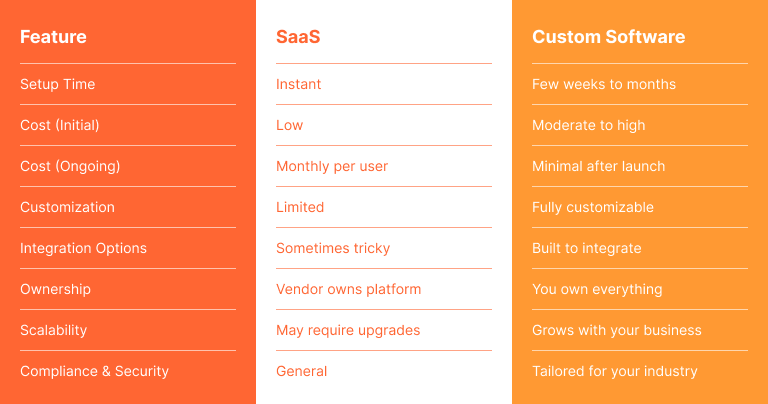
Real Value: Custom vs SaaS
Let’s break down the key differences in a simple comparison:
Finding the Right Balance Between SaaS and Custom Solutions
Choosing between custom software and SaaS isn’t always black and white. In fact, the smartest businesses today often use both.
The trick is knowing where to go custom and where to use something off the shelf. You don’t need to reinvent every wheel. Some parts of your business can run perfectly well on existing platforms. Others need deeper customization to support your unique workflows or give you a competitive edge.
Here’s what that might look like in real life:
- You use HubSpot to manage marketing campaigns and email automation, but build a custom client onboarding portal that fits your internal process
- You run your online store on Shopify, but manage inventory with a custom backend tool that works exactly the way your warehouse team needs
- You rely on QuickBooks for day-to-day accounting, but track detailed financial KPIs through a custom dashboard built for your leadership team
This combined setup gives you the best of both worlds. You move quickly with ready-made tools where speed and simplicity matter, and go custom in areas that need more precision or control.
The result? You’re not limited by generic platforms, and you’re not slowing yourself down by building everything from scratch. You create a tech stack that fits your business instead of forcing your business to fit the tools.
Cost Comparison: Short vs Long-Term
Let’s compare the costs over a five-year period for a mid-sized business:
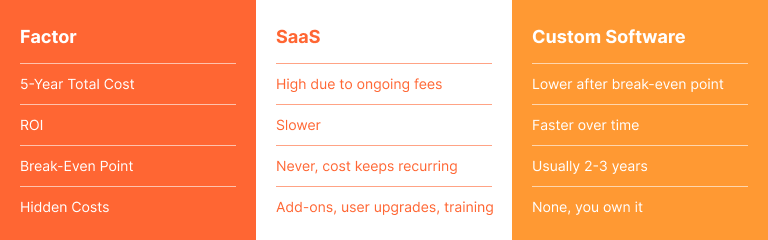
Key Stat: Businesses using custom solutions report an average ROI of 55% over five years, compared to 42% for SaaS implementation.
Security, Compliance, and Control
Security and compliance aren’t just checkboxes. For many businesses, especially those in regulated industries, they’re non-negotiable.
SaaS platforms often come with built-in security features, but those are designed to meet broad, general needs. You’re trusting the vendor to follow best practices and hoping their approach matches your requirements. But what if it doesn’t?
That’s where custom software gives you the upper hand.
With a custom solution, you’re in control. You decide:
- Where your data is located: Whether it’s on your own servers, a private cloud, or a region-specific data center to meet local laws
- Who has access: Set permissions based on roles, departments, or individual users
- What gets tracked: Build detailed audit trails, user activity logs, and alerts based on your internal policies
- How you stay compliant: Align the system with industry-specific standards like HIPAA, GDPR, SOC 2, or anything else you need to follow
This level of control becomes critical if you deal with personal health data, financial records, or confidential business information. It’s not just about checking a box. It’s about reducing risk and being able to prove it when it matters.
Custom software allows you to bake security and compliance into the foundation of your system, instead of patching it on top later.
Stay Ahead with Scalable Software
What works for your business at present might feel outdated in a year. As your team grows, your customers evolve, and the market shifts, your tools need to keep up.
That’s where custom software really shines.
With a tailored solution, you’re not boxed in by someone else’s timeline or limited by generic features. You can evolve your system as your business changes. Whether that means refining the user experience, integrating new tools, or introducing smart automation, you’re free to move at your own pace.
Custom software gives you the flexibility to:
- Add new features as your needs grow: No need to wait for a vendor update
- Improve the user experience based on real feedback: Make changes that your team and customers actually want
- Adapt to market changes quickly: Build or pivot faster than competitors relying on static tools
- Introduce automation or AI: Bring in advanced tech when the time is right, not when your software allows it
This kind of flexibility means you’re not just building for today. You’re creating a foundation that can grow with you for years to come.
How to Choose What’s Best for Your Business
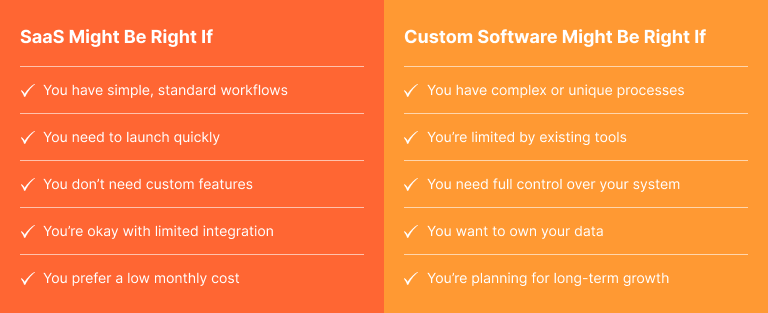
There’s no single right answer when it comes to choosing between SaaS and custom software. It depends on your team, your workflows, and how much flexibility you need.
Use this checklist to help figure out what fits your business best.
Conclusion
SaaS is a great starting point. It’s affordable, flexible, and easy to adopt. But as your business grows, runs into limitations, or needs more control, custom software becomes a smarter move.
It gives you the freedom to build exactly what your business needs, with no unnecessary extras and no missing pieces.
At Brevity Software Solutions, we help businesses design and develop custom software solutions that fits their needs, scales over time, and supports long-term goals. Whether you’re replacing existing systems or building something from scratch, we’re here to help.
Looking to build smarter, more tailored solutions?